
Case Study

Constrained Or Excess Supply - How Fair is your Inventory Allocation ? Distribution Planning at Flora Food Group

Constrained Or Excess Supply - How Fair is your Inventory Allocation ? Distribution Planning at Flora Food Group
Home› Insights› Case Study
Flora Food Group
Client case study · SAP IBPDelivered by Straveo

How fair share distribution in the SAP IBP supply planning optimizer balances constrained supply across the network, reduces repeated ad hoc planning runs and improves customer service levels.

€3.0bnnet sales value, 2025
1.0%net sales CAGR, 2019 to 2025
100+countries served
14manufacturing sites
01

Client and context

Headquartered in Amsterdam with 150+ years of heritage, Flora Food Group delivers culinary essentials through brands such as Flora, Becel+ProActiv, Blue Band, Country Crock, Rama and Violife.

For instance, ProActiv Olive Oil is produced at one plant and shipped to several distribution centres (DCs). In the best case, every DC gets what it asks for in a planning period. When demand runs ahead of supply, planners face a dilemma: how to share the limited stock fairly, so that no DC runs out of inventory and no customer is compromised.

Source: Flora Food Group Annual Report 2025

Flora Food Group products including ProActiv Olive Oil, Flora, Rama, Violife and Blue Band
02

The problem

When ProActiv Olive Oil supply fell short of demand, the IBP Optimizer followed its default goal of minimising cost, not balancing the supply allocation. With no fair inventory allocation rules configured, stock gravitated to particular DCs while others ran short, and planners were compelled to take multiple ad hoc planning runs and make manual adjustments.
Skewed allocationRegular optimization favoured one DC over the others.
Surplus and stock-outsExcess stock at some DCs, stock-outs at others.
Manual overridesWhen supply was short, manual adjustments by planners were inevitable.
Uneven service levelsFulfilment rates differed across the network.
One plant, three DCs, not enough supply for allWithout fair share, cost-led optimization sends most of the stock to one DC and leaves the others short.
RequestedAllocatedBeyond need
Plant
ProActiv
Olive Oil
Constrained supply
DC1
Requested
Allocated
Excess stock
DC2
Requested
Allocated
Running short
DC3
Requested
Allocated
Stock-out risk
Supply gravitates to the lowest-cost DC.
Surplus at one DC, stock-outs at the others.
Ad hoc planning run overrides every time supply is short.
03

How it works in SAP Integrated Business Planning (IBP)

With fair share enabled, the IBP Optimizer shares constrained supply in proportion to each DC’s requirement. It fills every DC step by step, in segments, and makes sure no DC moves to the next segment until all the others have reached it. So all DCs’ supply moves together in the same band.

Segments fill step by stepEach segment is shared across all DCs before the next one begins.
Filled bottom to topDC1DC2DC3
Segment 475-100%
Segment 350-75%
Segment 225-50%
Segment 10-25%
Allocation priority
4Excess stockFilled last
3Max stock
2Safety stock
1Primary demandFilled first
Level 1
Level 4

Supply fills from the bottom up. The allocation at each level is fair across all DCs before supply moves on to build any excess stock.
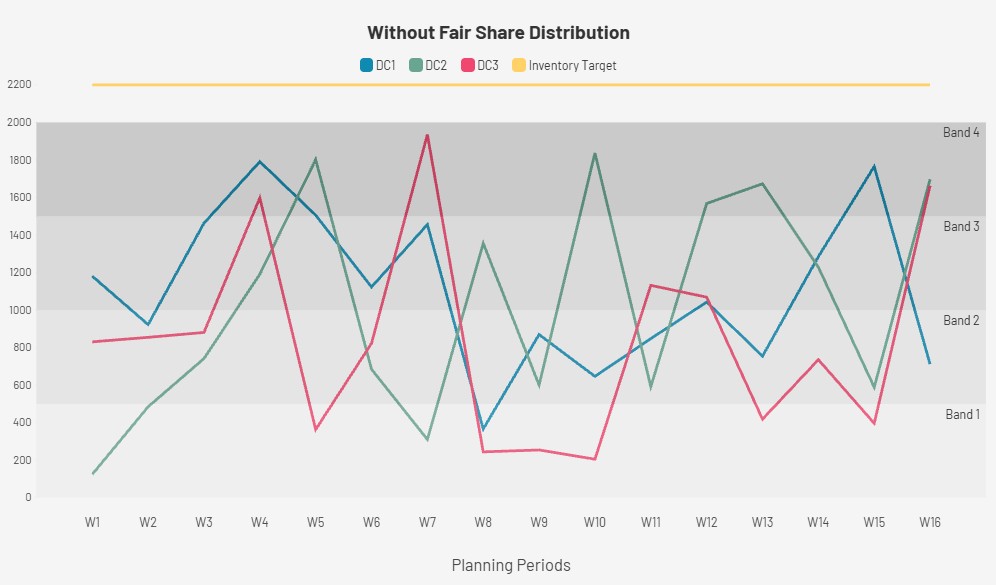
Before: without fair shareProjected stock by DC, weeks 1 to 16.
Line chart without fair share: DC1, DC2 and DC3 projected stock scattered across bands 1 to 4 over weeks 1 to 16, below the inventory target
DCs scattered across bandsOne DC favoured
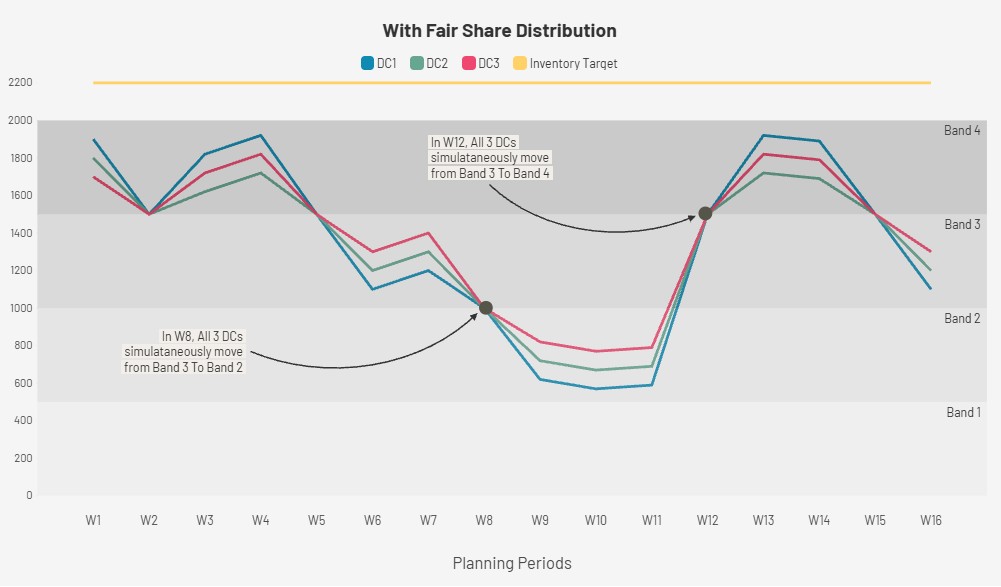
After: with fair shareProjected stock by DC, weeks 1 to 16.
Line chart with fair share: DC1, DC2 and DC3 projected stock move between bands together, all moving from band 3 to band 2 in W8 and from band 3 to band 4 in W12
DCs move between bands togetherNo DC left behind

Fair share works best when DCs share similar lead times, costs and planning parameters; where they differ, overall cost can still pull the allocation.

Executed with the SAP Integrated Business Planning Optimizer.
04

Solution and implementation

PROPOSED SOLUTIONStraveo proposed proportional, demand-based fair inventory allocation within the IBP Optimizer, so constrained supply is shared across DCs by clear rules instead of ad hoc planning run overrides and manual adjustments, in a way that scales across the entire supply chain network.
IMPLEMENTATIONFair share was configured to the inventory levels maintained by the business, tested on the plant-to-DC network, and finally rolled into dedicated optimizer profiles and job templates that planners run like any other plan.
1Define segmentsSupply is shared across DCs step by step, one segment after another.
2Align cost rulesHolding, target and max stock violation costs set consistently across DCs.
3Run distribution planningDedicated fair share S&OP profiles and job templates.
4Review outputsStock against target and against max stock, shown side by side for each DC.
05

Impact on the business

Before vs after fair share planning

BeforeAfter
Skewed allocation between DCsLower
Stock-outs at DCsLower
Manual overridesLower
Customer service levelsHigher

Bars show the direction of change and are not to scale.

WORK WITH STRAVEOFewer stock-outs, fair inventory allocation across every node.

If some nodes run short while others overflow, your network may see frequent drops in customer service levels, or working capital tied up in excess stock. Our SAP IBP experts can help you review and rebalance it.

1Inventory allocation reviewWhen constrained supply is skewing your multi-echelon network with an inefficient supply plan
2Fair share in SAP IBPSegments, cost rules and optimizer profiles in your IBP tenant
3Supply planning optimizer and inventory optimizationReview, set-up, tuning and planner adoption
Start a conversation

Tell us about your planning challenges and our planning expert will reach out to explore how we can enhance your supply planning and help you drive more value.

  • Allocation review
  • Fair share
  • Optimizer
Request a conversation

Reading is fine. Doing is better.

Show me my AI maturity level